Look Left Right Then Left Again
Affiliate 4
Affiliate 4: Signals, Signs and Pavement Markings
Traffic Control Signals
Traffic signals are placed at intersections to proceed traffic moving and avoid accidents. Drivers, pedestrians, and cycle riders must obey these signals except when an officer is directing traffic. Stop on the end line if your car is nearest the signal. Some signals change only when a motorcar is at the end line. If traffic signals are out of social club, stop as yous would for a four-way terminate sign.
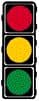
Reddish
Come to a consummate stop at the marked stop line or before moving into the crosswalk or intersection. After stopping, you may turn right on red at most intersections if the way is clear. Some intersections display a "NO TURN ON RED" sign, which you must obey. Left turns on red from a one-way street into a one-fashion street are as well allowed.
YELLOW
Stop if you can. The light will shortly be ruby.
Dark-green
Go — but only if the intersection is articulate. Yield to pedestrians and vehicles withal in the intersection. If turning left, wait for gap in oncoming traffic to complete turn.
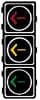
RED Pointer
Come up to a consummate stop at the marked finish line or before moving into the crosswalk or intersection. Afterward stopping, you may turn right on scarlet arrow at most intersections if the way is clear. Some intersections display a "NO TURN ON RED" sign, which you must obey. Left turns on red arrow from a one-way street into a one-way street are also allowed.
Yellow ARROW
Stop if you can. The light will soon be red. The yellow arrow ways the aforementioned as the yellow light, but applies but to move in the direction of the arrow.
Greenish ARROW
A green arrow, pointing right or left, means you lot may make a turn in the management of the arrow. If the reddish light is burning at the same fourth dimension, you must be in the proper lane for such a turn, and you must yield the right-of-way to vehicles and pedestrians inside the intersection.
FLASHING SIGNALS
A flashing red light means the same thing equally a end sign. It is used at unsafe intersections.
A flashing yellow light means you may motility forward with circumspection. It is used at or just earlier dangerous intersections, or to alert you to a warning sign such equally a schoolhouse crossing or precipitous bend.

LANE SIGNALS
Lane signals are used:
- When the direction of the flow of traffic changes during the day.
- To show that a toll booth is open or closed.
- To show which lanes are opened or closed.
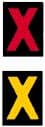

You must never bulldoze in a lane under a red X. A yellow X means that your lane signal is going to alter to blood-red. Prepare to leave the lane safely. You may bulldoze in lanes beneath the light-green pointer, but y'all must also obey all other signs and signals.
Traffic signs — Standard Shapes and Colors
There are eight shapes and eight colors of traffic signs. Each shape and each color has an verbal meaning, so you lot must accustom yourself with all of them.
- Light-green: Guide, directional information.
- Ruddy: Stop, do not enter or wrong way.
- Blue: Motorist services guidance. Likewise used to identify parking spaces for disabled drivers.
- ORANGE: Construction and maintenance.
- BROWN: Public recreation areas and breathtaking guidance.
- YELLOW: Full general alarm.
- WHITE: Regulatory.
- BLACK: Regulatory.
The shape of a road sign can tell y'all as much virtually the sign's message as its color.

OCTAGON: Exclusively for terminate signs.
HORIZONTAL RECTANGLE: Generally for guide signs.
TRIANGLE: Exclusively for yield signs.
PENNANT: Advance alarm of no passing zones.

DIAMOND: Exclusively to warn of existing or possible hazards on roadways or adjacent areas.

VERTICAL RECTANGLE: By and large for regulatory signs.

PENTAGON: School advance and school crossing signs.
ROUND: railroad accelerate alert signs.

CROSSBUCK: Railroad crossing.
 Octagon: Stop
End signs are e'er octagonal (8 sided). A stop sign means that you must bring your vehicle to a complete halt at the marked stop line.
If there is no marked end line, cease before entering the crosswalk on the most side of the intersection. If there is no crosswalk, finish at a point nearest the intersecting roadway where you take a clear view of approaching traffic on the intersecting roadway before entering the intersection.
A four-mode stop sign means that there are four stop signs at this intersection. Traffic from all four directions must finish. The first vehicle to achieve the intersection should move forward first. If two vehicles reach the intersection at the same time, the commuter on the left yields to the driver on the correct.
 Triangle: Yield
Tedious downwards and give vehicles crossing your path the right-of-mode. If the way is articulate, yous may movement forward slowly without stopping. Yield signs are usually placed where auxiliary roads pb into major roads.
 Pennant: No Passing
You are entering a no passing zone. This sign is placed on the left side of the road, facing the driver.
 Diamond: Alarm
Narrow bridge. These signs warn you of special weather condition or dangers alee. Words or symbols on the sign will testify why you demand to use circumspection. See pages 58-60 for typical warning signs.
 Pentagon: Schoolhouse Sign:
This five-sided sign means yous are nigh a school. Watch for children.
 School Crossing
As yous arroyo this sign, irksome down, picket for children crossing the road. Cease if necessary. Obey signals from any crossing guards.
Children Crossing
Slow to posted speed. Watch for children!
Warning Signs
Here are some common warning signs. These signs give y'all advance detect of possible hazards ahead. Drive with circumspection.
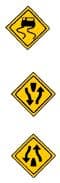
- Glace WHEN Wet. In wet weather, drive slowly. Do non speed upwards or brake quickly. Make sharp turns at a very tedious speed.
- DIVIDED HIGHWAY Ahead. The highway ahead is divided into two one-mode roadways. Continue to the right.
- DIVIDED HIGHWAY ENDS. The divided highway on which y'all are traveling ends 350 to 500 feet alee. Yous will then exist on a roadway with 2-way traffic. Continue to the correct.
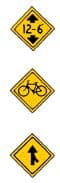
- LOW CLEARANCE. Practise not enter if your vehicle is taller than the height listed on the sign.
- BICYCLE CROSSING. Warns you lot in advance that a bikeway crosses the roadway alee.
- MERGING TRAFFIC. Yous are coming to a point where another traffic lane joins the 1 you are on. Watch for other traffic and be ready to yield the right-of-manner when necessary.
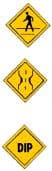
- PEDESTRIAN CROSSING. Picket for people crossing the street. Dull downwardly or stop if necessary.
- NARROW BRIDGE. The bridge is broad plenty to accommodate two lanes of traffic, but with very little clearance.
- DIP. There is a low place in the road. Go slowly and be prepare to finish if the dip is filled with water.
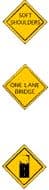
- SOFT SHOULDER. The clay on the side of the road is soft. Don't go out the pavement except in an emergency.
- ONE LANE Bridge. The span is wide enough for only one vehicle at a time. Make sure the span is clear of oncoming traffic before yous cross.
- PAVEMENT ENDS. Road surface ahead changes from a hard surfaced pavement to a low-type surface or earth road.
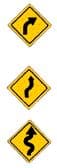
- Right CURVE. Ho-hum your speed and proceed well to the left. The road will bend to the right.
- DOUBLE CURVE. The route volition curve to the right, then to the left. Slow your speed, continue to the correct, and do not pass.
- WINDING Route. At that place are several curves ahead. Bulldoze slowly and carefully.
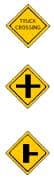
- TRUCK CROSSING. Scout for trucks entering or crossing the highway.
- Cross ROAD. A road crosses the main highway ahead. Expect to the left and right for other traffic.
- SIDE ROAD. Some other road enters the highway from the management shown. Watch for traffic from that direction.
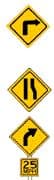
- SHARP Correct TURN. The road will make a sharp plow to the right. Slow your speed, go on to the right, and do non pass other vehicles.
- REDUCTION OF LANES. There will be fewer lanes alee. Traffic must merge left. Drivers in the left lane should allow others to merge smoothly. Correct lane ends.
- Advisory SPEED SIGN. The highest safety speed you should travel around the curve alee is 25 miles per hr. Advisory speed signs may exist used with any diamond-shaped warning sign.
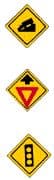
- Hill/DOWNGRADE. Tiresome down and be prepare to shift to lower gear to command speed and save brakes.
- YIELD AHEAD. Alarm of yield sign ahead. Slow downward and be prepared to stop at yield sign or adjust speed to traffic.
- TRAFFIC SIGNAL Alee. Alert of traffic signals at intersection ahead. Slow downwards, poor visibility is likely.
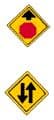
- Finish SIGN Ahead. When you come to this sign, slow down to be ready to stop at the cease sign cheque.
- Ii-Fashion TRAFFIC AHEAD. The one-way street or roadway ahead ends. You volition then be facing oncoming traffic.
Rectangle: Regulatory or Information
These signs tell you the law, then you must follow their instructions.
 Recall that a crimson circumvolve with a slash means NO. The sign shows yous what is not immune.
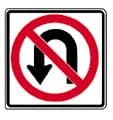 NO U-Turn. — Y'all cannot make a complete turn to go in the opposite direction where this sign is displayed. No U-plow.
 You must not make a right plough at this intersection.
 fifty miles per hour is the highest safest speed you tin can travel in this area.
 You cannot go straight ahead. You must turn either to the right or left.
 Y'all are going the wrong way on an expressway exit ramp. Do not drive by this sign. Plow around immediately.
 A divided highway is ahead. Stay on the right side of the divider.
 Parking only for vehicles displaying an official let and transporting a disabled person.
 You may travel only in the direction of the arrow.
 This sign lists the maximum recommended safety speed for an entrance or leave on an motorway. Slow downward to whatever speed is shown.
 You may not turn correct or left during the red light. You must await for the signal to turn dark-green.
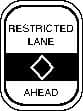 A diamond-shaped marking shows that a lane is reserved for certain purposes or sure vehicles. The lanes are usually reserved for buses or automobile-pool vehicles during rush hour traffic. Other diamond signs are used to designate wheel lanes.
 The middle lane is shared for left turns in both directions of travel.
 Y'all must not pass whatever other vehicles going in the same direction as y'all are, while you are in this area.
 When you have passed this sign, you are again permitted to laissez passer other vehicles with care.
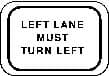 Traffic in left lane must plough left at the intersection ahead.
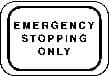 Stopping permitted only for emergencies.
 You lot are approaching an surface area where a reduced speed zone has been established.
 At the intersection ahead traffic in left lane must plough left and traffic in adjoining lane may turn left or continue directly ahead.
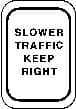 This sign is used on multiple lane highways to advise slower driving traffic to stay in the right hand lane; and also to do so when approached from behind past other traffic fifty-fifty if yous are doing the speed limit.
 This marks a one-fashion roadway with traffic coming toward y'all. You must not enter the ane-mode roadway at this point.
 You must non plough either to the right or to the left at this intersection.
 If you lot park, you must ever park off the pavement of the highway.
 When entering a correct turn lane motorists volition conflict with bicycle through movements. Always yield.
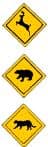 Creature CROSSING. The animal pictured on the sign is common in this area: watch for this species crossing the road specially during twilight and nighttime hours.
Railroad Crossing Signs and Signals
There are several signs, signals and pavement markings that bespeak highway railroad crossings. When you see 1 of them, slow downwards and exist ready to cease.
Retrieve:
Trains cannot stop speedily. An average freight railroad train traveling at 30 MPH needs a stopping distance of more than than one-half a mile. Longer trains moving at faster speeds can accept ane and a one-half miles or more than to stop.
Whatsoever pedestrian or person driving a vehicle and approaching a railroad highway grade crossing must stop within 50 feet simply not less than 15 feet from the nearest rails of the the railroad when the electric or mechanical warning devices are flashing, the crossing gate is lowered, a homo flagger is warning of an approaching train, or an budgeted train is clearly visible and is in close proximity to the railroad highway grade crossing. Do non keep until yous tin can practice so safely.
PAVEMENT MARKING
Pavement markings, consisting of an RXR followed by a terminate line closer to the tracks, may exist painted on the paved arroyo to a crossing. Any person walking or driving a vehicle must finish inside 50 feet but not less than 15 anxiety of the crossing. Stay behind the stop line while waiting for a train to pass.
Advance WARNING SIGN
The advance warning sign is usually the first sign you meet when budgeted a highway-runway intersection. The advance warning sign advises you to ho-hum downward, expect, and listen for a train, and exist prepared to terminate if a train is budgeted.
CROSSBUCK SIGN
Crossbuck signs are plant at highway-track intersections. They are yield signs. You are legally required to yield the right of mode to trains. Dull down, expect and listen for a railroad train, and stop if a train approaches. When the road crosses over more than one set of tracks, a sign below the crossbuck volition indicate the number of tracks.
FLASHING Cherry LIGHT SIGNALS
At many highway-runway crossings, the crossbuck has flashing cherry lights and bells. When the lights begin to flash, stop! A railroad train is budgeted. DO NOT STOP ON THE TRACKS OR WITHIN SIX Anxiety OF EITHER RAIL. Do not move forward until you tin can do and so safely. If at that place is more than one rail, make sure all tracks are clear before crossing. In heavy traffic make certain there is room for your vehicle on the other side earlier starting to cross.
GATES
Many crossings accept gates with flashing red lights and bells. Stop when the lights begin to flash, and before the gate lowers across your side of the road. Do not move forward until the gates are raised and the lights stop flashing as there may be a railroad train approaching on an adjacent track.
Always approach highway-railroad crossings at a reasonable speed — and be prepared to stop if y'all have to. Exist especially alarm when you are post-obit buses or trucks which may take to end at highway-railroad crossings even if whatsoever gates are up and the warning lights are non flashing.
If your motorcar stalls on the tracks don't hesitate. Get yourself and your passengers out and abroad from the car immediately. If a collision is imminent, the safest direction is toward the railroad train but stay off the tracks. That way you will be least probable to be hit by your vehicle or whatever debris from the collision.
Structure and Maintenance Traffic Control Signs
Various traffic command devices are used in road construction and maintenance work areas to direct drivers and pedestrians safely through the work site and to provide for the safety of highway workers.
Be prepared to reduce your speed and use circumspection when directed to do and then by a sign, flagger and/or police officer.


Structure and maintenance signs are used to notify drivers of unusual or potentially dangerous weather in or nigh piece of work areas. Most signs used in highway and street piece of work areas are diamond shaped.
Channeling Devices
Barricades, vertical panels, drums, and cones are the nearly commonly used devices to alert drivers of unusual or potentially dangerous atmospheric condition in highway and street work zones. These devices are used to guide the drivers safely through the work surface area, and at night, they may be equipped with warning lights. When a Road Closed sign is displayed, practice not drive on this road. Wait for a detour or another road.
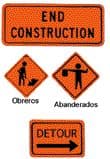
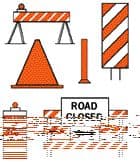
Stripes on barricades and panel devices slope downward in the direction traffic must travel.
Flashing Pointer Panels
Flashing pointer panels are used both during the 24-hour interval and at nighttime to requite advance warning and directional information to drivers where it is necessary to move to the right or to the left into another lane.
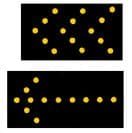
A horizontal flashing bar indicates a warning — use circumspection approaching the piece of work area.
Flaggers
Flaggers are often provided in highway and street work zones to stop, boring, or guide traffic safely through the area.
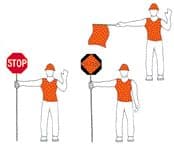
Flaggers wear orange vests or jackets and use red flags or stop/deadening panels to directly traffic through work zones.
Special Signs
 Deadening MOVING VEHICLE
Vehicles going less than 25 miles per hour (such as farm equipment) must display this sign on the rear when using public highways.
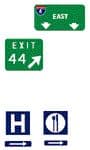
 GREEN GUIDE SIGNS
Green and white signs give information most directions and distances. Guide signs on expressways testify y'all which lanes to use to get where you lot want to become.
Routes that run generally East-Westward have even numbers and those running North-South accept odd numbers.
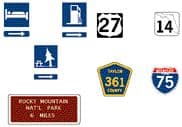
Blueish SERVICE SIGNS
Blue and white signs directly you to services, such equally gas, food, motels and hospitals. Chocolate-brown and white signs point out breathtaking areas and parks.
Pavement Markings
Lines, symbols and words are often painted on a roadway to aid direct drivers and command traffic menstruation. You must know what the different lines and colors mean and obey them equally you lot would traffic signs or signals.
White and xanthous lines are used along pavement edges and between lanes to keep vehicles in line. These lines may exist solid or broken (long dashes), single or double.
Unless you are turning, exiting a highway, or changing lanes, always stay between the lines marking your lane.
Yellow Lane Lines
Yellow lane lines carve up lanes of traffic moving in contrary directions. Unmarried yellow lines may likewise mark the left edge of the pavement on divided highways and one-mode streets.
- A Broken Yellow Line
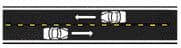
A broken yellow line separates lanes of traffic moving in opposite directions. Stay to the right of the line unless you are passing a vehicle in front end of you. When passing, you may cross this line temporarily when it is safe to do so.
- Double Yellow Lines: One Solid, 1 Broken.
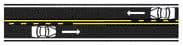
A solid yellow line to the right of a broken yellowish center line means passing or crossing is prohibited in that lane, except when turning left. If the broken line is closer to you, and so you can the broken line just to pass another vehicle and simply when it is condom to practice so.
- Double Solid Yellow Lines
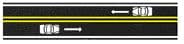
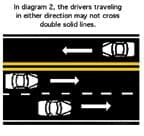
Double, solid yellow lines prohibit vehicles moving in either direction from crossing the lines. You may not cross these lines unless turning left when it is safe to do so.
White Lane Lines
White lane lines dissever lanes of traffic moving in the aforementioned direction. Single white lines may also mark the right border of the pavement.
- Cleaved White Line
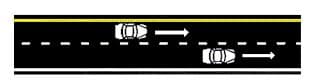
Broken white lines separate lines of traffic going in the same direction. They may be crossed with care.
- Solid White Line
A solid white line marks the border of the roadway or separates lanes of traffic moving in the same direction. You may travel in the aforementioned management on both sides of this line, but you should non cross the line unless y'all must practise so to avoid a take chances.
- Double Solid White Line
Double solid white lines signal that changing lanes is not allowed.
- Solid with Plough Lane Arrow
Solid white lines are used for turn lanes and to discourage lane changes near intersections. Arrows are frequently used with the white lines to prove which turn may exist made from the lane.
If y'all are in a lane marked with a curved arrow and the give-and-take Merely, y'all must plow in the direction of the arrow. If your lane is marked with both a curved and straight arrow, you may either turn or go directly.
Reversible Lanes
Some highways have reversible traffic lanes to help handle blitz-hr traffic. The direction of traffic is usually reversed at gear up times each solar day. These pavement markings are used along with special lane signals and other signs and symbols.
A solid white line marks the border of the pavement on nearly roads. Stop lines, crosswalks and parking spaces are also marked by white lines. Symbols such as arrows are in white also. A unmarried yellow line marks the left edge of all divided or one-mode roadways. Curbs are often marked yellowish in no-parking zones nigh fire hydrants or intersections.
It is unlawful to park in or drive through areas that have pavement markings indicating fire lanes or safety zones.
The lane marker arrow, in the middle lane in the diagram beneath, indicates that traffic in this lane can be reversed in accordance with local traffic controls due to "rush hour" traffic or other special traffic atmospheric condition.
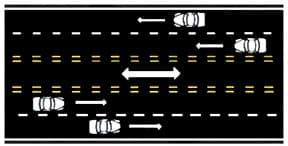
Two-Way Roadway with Heart Lane
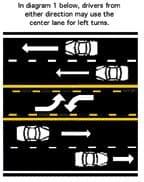
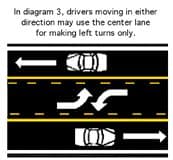
Ii-style roadway with a center lane for left turns in either direction of travel. The especially marked heart turn lane is intended for slowing downwards and for sheltering of turning vehicles and may non exist used for passing.
- Go to Affiliate five
- Return to Table of Contents
moorefoelonemse61.blogspot.com
Source: https://www.stateofflorida.com/traffic-signals/
0 Response to "Look Left Right Then Left Again"
Post a Comment